Each claim ships with concrete evidence — env vars, table names, cadence chips. No marketing fluff.
◆DesignA hero shot on the real floor — not clip art
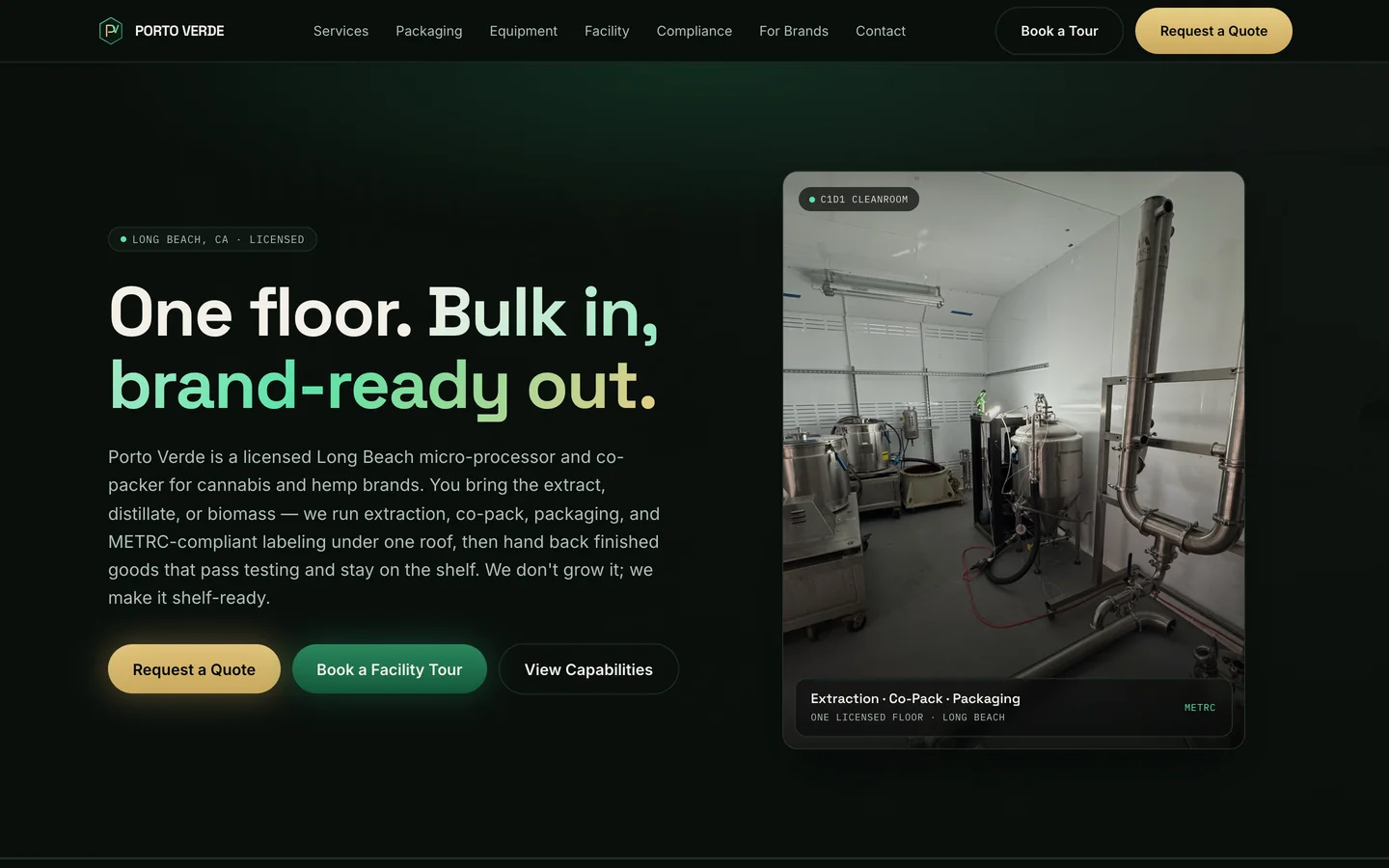
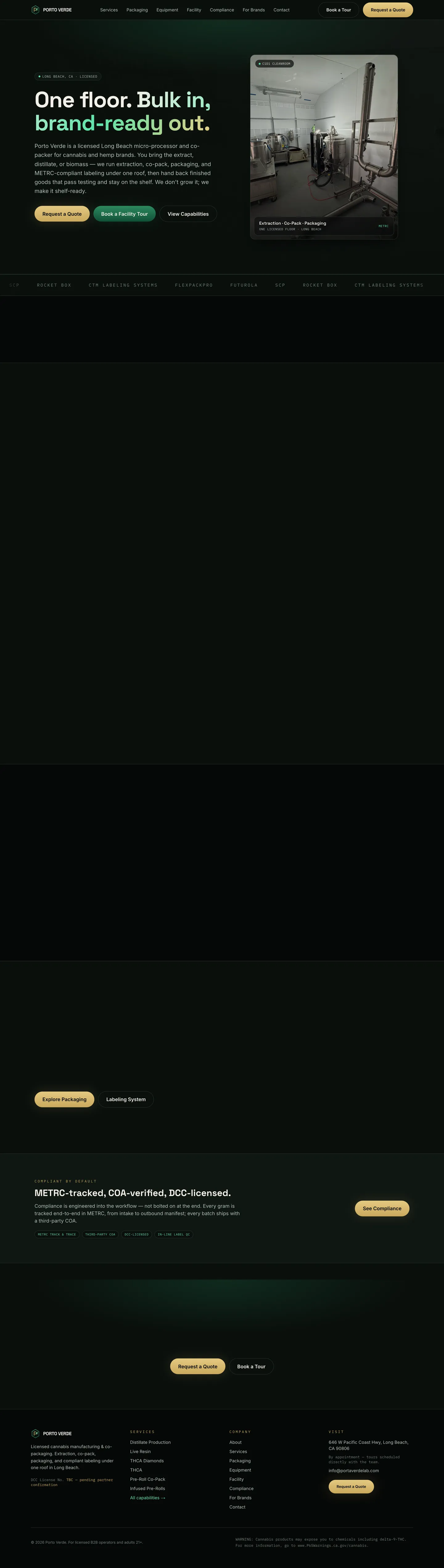
The landing hero is a clean editorial composition: a framed plate of the actual C1D1 extraction cleanroom with a glass spec rail (Extraction · Co-Pack · Packaging · METRC). An earlier draft used a gimmicky parallax-tilting, idle-bobbing photo cluster borrowed from another site; it was scrapped for the static, confident composition a procurement buyer expects. Real facility photography (extraction skid, cleanroom, Futurola staging, labeling room) carries every service and equipment page.
- Before
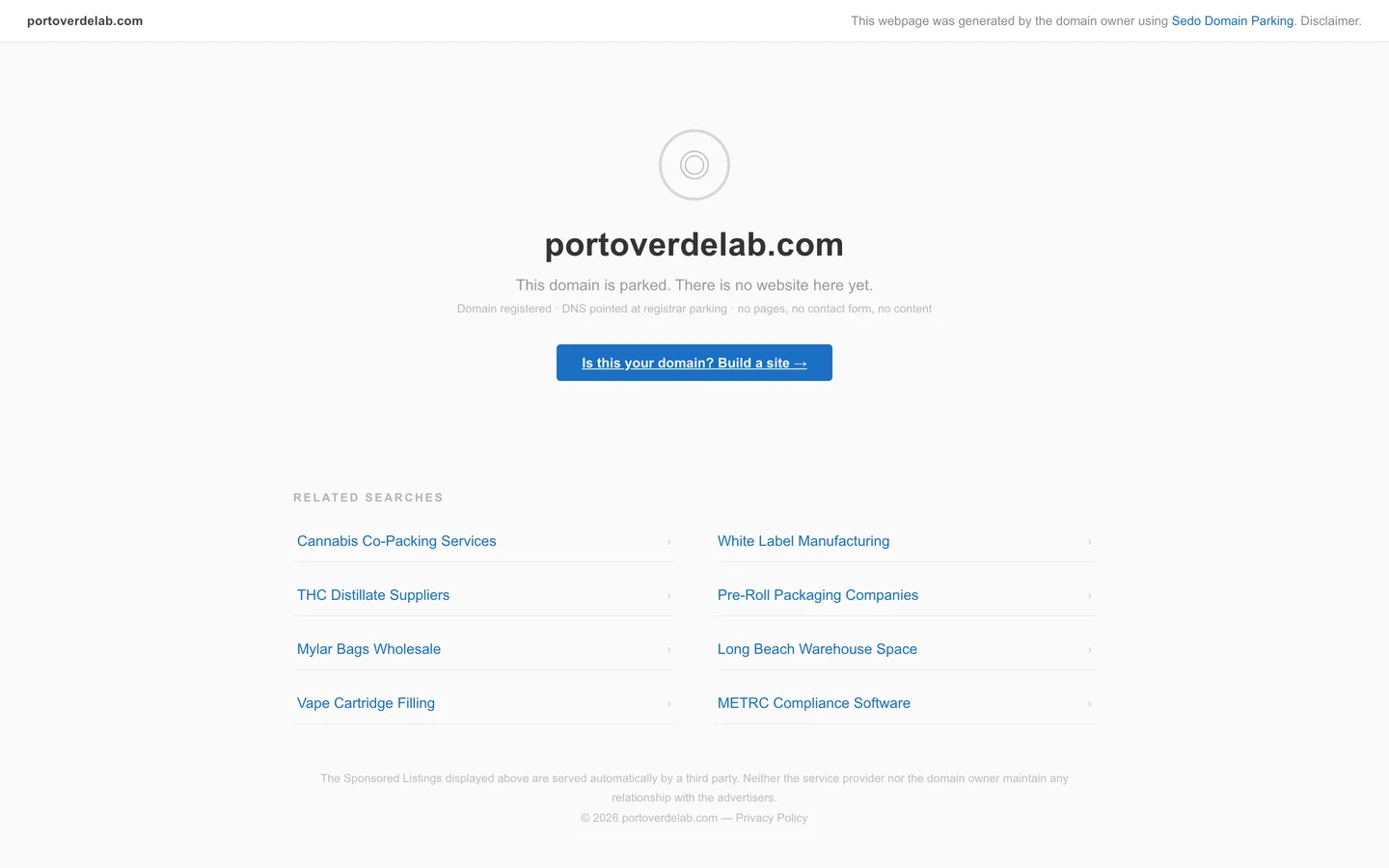
- No site at all — a registrar parking page with sponsored-search spam.
- After
- A facility hero + real floor photography across 13 pages.
◆DesignIndustrial-premium positioning — and honest about what the lab is
Green / brass-gold / near-black, Space Grotesk + Inter, generous whitespace — pharma-grade, not dispensary kitsch, no leaf clichés. Just as important, the copy is precise about the business: Porto Verde is a micro-processor and co-packer, so the site never claims to cultivate. Flower appears only as a brand-supplied input ('you bring the extract, distillate, or biomass'); 'seed-to-sale' was replaced with 'intake-to-manifest' throughout.
- Before
- Nothing communicated what the lab does, or doesn't, do.
- After
- A B2B identity that reads as a manufacturer — accurate to the license.
◉RetentionA quote funnel that takes the brand's artwork
The conversion path isn't a mailto: link. It's a structured Request-a-Quote form — company, contact, product type, multi-select services, volume, timeline — with a drag-and-drop artwork dropzone that accepts PDF / AI / PSD / EPS / PNG up to 100 MB via presigned direct-to-storage uploads, with per-file progress and a spam honeypot. Submissions land in Neon and notify the operator by email.
- Before
- Reachable by phone and word of mouth; no way to send a brief or artwork.
- After
- Brands scope a project and upload print-ready files in one step.
△Agent backboneA one-letter domain typo, migrated across 8 live systems with zero downtime
After launch the owner noticed the domain was misspelled — portAverde, not the brand's portOverde — and bought the correct one. Instead of a risky big-bang cutover, the whole stack was migrated in place and verified live the same session: site code + canonical/OG, the Vercel project domain, GoDaddy DNS, the self-hosted email domain + four mailboxes, the AWS SES identity + DKIM, every email environment variable, and this case study itself. The misspelled domain wasn't deleted — it was re-pointed as a 308, path-preserving redirect, so a typo or an old link still lands the visitor on the exact right page.
- Before
- Whole site + email built on a misspelled domain.
- After
- Everything on the correct domain; the typo domain 308-redirects to it.
- ▸Correct domain verified live (HTTP 200, valid SSL) the same session
- ▸Old domain decommissioned from Vercel + the mail server, then re-added as a redirect
- ▸portaverdelab.com/equipment → 308 → portoverdelab.com/equipment (path preserved)
◉RetentionReal, self-hosted email on owned infrastructure — DKIM-aligned, not a SaaS inbox
Email doesn't run on Google or Microsoft — it's a self-hosted Stalwart server (Hetzner) relayed through AWS SES. Provisioned info@, accounts@, sales@, and noreply@ with MX, SPF, DMARC, the server's own DKIM, and three SES DKIM CNAMEs so outbound passes DMARC alignment; the SES identity verifies clean. The site's quote funnel sends lead notifications through this pipeline, with replies threaded back to the brand that submitted.
- Before
- No domain email at all.
- After
- Four DKIM-aligned mailboxes on infrastructure the operator owns.
- ▸4 mailboxes provisioned via the operator's own claw_mail toolkit (idempotent, API-published DNS)
- ▸SES identity Verified; DKIM-aligned outbound
- ▸Lead form → noreply@ SMTP → routed to info@ / sales@
△Agent backboneAn honest engine — every unverified number wears a 'TBC'
Procurement sites lie with confidence; this one refuses to. Throughput, MOQ, lead times, and the DCC license number render with a visible 'TBC' marker until the partner confirms the real figure, and the equipment specs are softened to vendor-published classes rather than invented precision. The build ships placeholders honestly instead of fabricating receipts — the same operating principle as the rest of the portfolio.
- Before
- No claims at all.
- After
- Real claims where verified; visible TBC markers everywhere else.
△Agent backboneEquipment transparency the LA co-pack market doesn't offer
A dedicated equipment page names the actual hardware — CTM Front/Back/Wrap pressure-sensitive labeling (vendor-published 90–120 ft/min) and FlexPackPRO thermal-transfer coding (up to ~32 in/sec, ~300 dpi class) — alongside the extraction, pre-roll, cart, and gummy lines, with real photos of the floor. A competitive scan of six LA / Long Beach co-packers found none that show a per-batch COA portal, live throughput, or their machines; this page is built to own that gap.
- Before
- No equipment, no specs, no proof of capability.
- After
- Named machines + vendor specs + real floor photos.